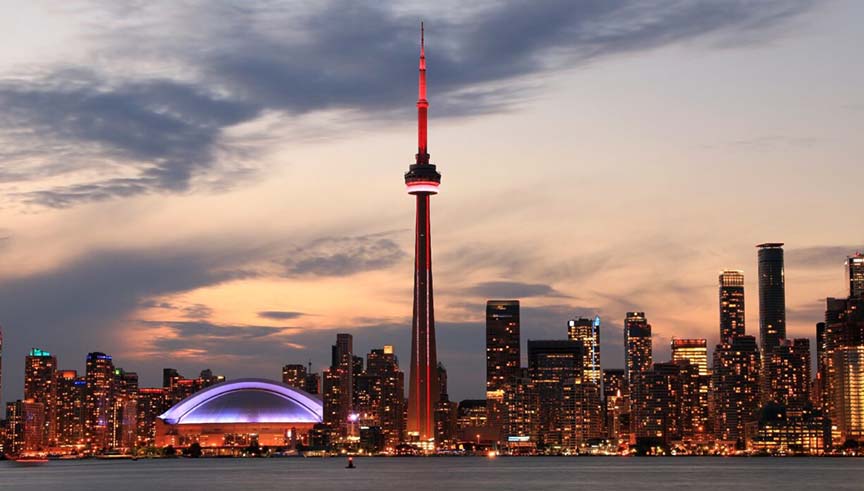
I entered downtown Toronto at dusk during my first visit. As the plane landed, a sprawling ribbon of city lights stretched out beyond the window; there was no ostentatious skyline, yet the city felt solid and vast.
On the journey from the airport to the city center, I realized that this city was completely different from Vancouver, which I had visited previously. Vancouver felt like a city embraced by nature, whereas Toronto felt like an “expansion of the urban fabric itself”—high-rises, streets, traffic, and crowds all in constant, steady motion.
Yet, strangely, it didn’t feel oppressive; instead, there was a sense of stable order.
The CN Tower: Witnessing Toronto’s Height for the First Time
My first stop after arriving was the CN Tower.
Standing at the base and looking up, the impression was immediate—not one of sheer awe, but a tangible sense of “real, towering height.” Unlike some complex city landmarks, it was a purely vertical structure.
When I later ascended to the observation deck, the city unfolded beneath my feet. Toronto’s layout was remarkably clear: streets extending in a grid, the lake shimmering in the distance, and a dense yet organized arrangement of buildings.
What struck me most wasn’t the height, but the city’s “readability.” You could instantly grasp how the city functioned.
Stepping onto the glass floor and looking down, I hesitated for a moment but quickly regained my composure; the city exuded a sense of stability rather than adrenaline-fueled excitement.
Lake Ontario: A Different Kind of Breath at the City’s Edge
The next day, I visited the waterfront area near Lake Ontario.
The walk from downtown to the lakeshore was fascinating: one moment I was surrounded by skyscrapers and traffic, and the next, I was facing the open expanse of water.
The lakeside breeze was distinct, carrying a hint of chill. In the distance, the Toronto skyline was visible—the CN Tower still stood out clearly, though it appeared small in scale.
I sat on a lakeside bench for a long time, watching the shifting waters. People were jogging, cycling, or simply sitting quietly in thought.
In that moment, I realized that Toronto isn’t “just a city”; it possesses a vast buffer zone—and that zone is the lake.
The Toronto Islands: A Bit of Distance from the City
Afterward, I took a boat to the Toronto Islands.
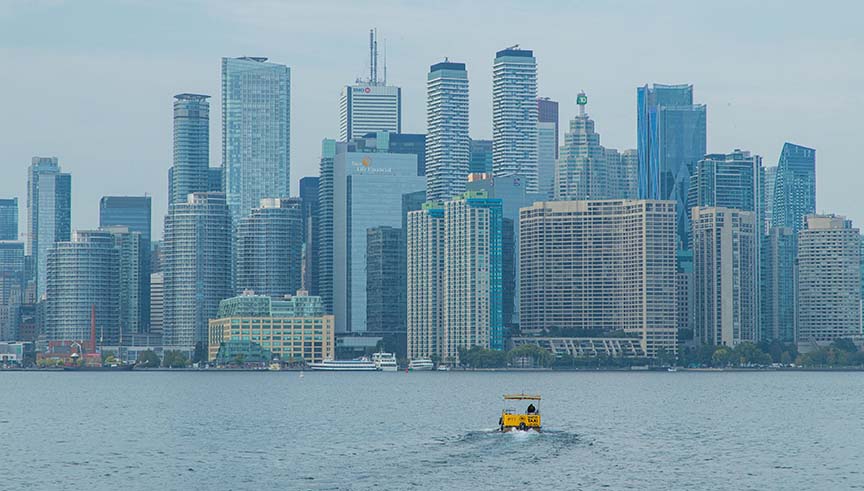
As the ferry pulled away from downtown, the city receded, and the skyline gradually flattened into a single line. In just over ten minutes, the atmosphere shifted completely—the noise of traffic vanished, replaced only by the sound of wind and water.
The islands were peaceful, defined by a landscape of bicycle paths, grassy lawns, and small beaches. I rented a bike and took a leisurely ride, weaving through the shade of the trees and along the lakeshore.
The most interesting moment was looking back at the city: Toronto sat just across the water—distinct yet distant. That sense of space made the city feel less “oppressive” and more like a place one could choose to approach.
The experience on the islands made me feel that Toronto had, in a way, kept a retreat for itself.
Multicultural Cuisine: The True Heart of the City
In Toronto, food isn’t just an add-on experience; it is an integral part of the city’s very fabric.
I wandered into a random Chinese restaurant downtown and ordered a plate of roast meat over rice. The flavor was solid—no forced innovation, just reliable, authentic quality. At the next table sat a Cantonese-speaking family; at another, white-collar workers who had just finished their shifts.
Later, I tried Korean, Japanese, Indian, and Middle Eastern cuisines—each naturally coexisting on the same city block.
What makes Toronto unique is that you don’t perceive these foods as “belonging to different countries”; instead, they all simply belong to the same city.
This diversity isn’t a staged display; it is the organic result of long-term, everyday living.
Urban Daily Life: Shopping and the Rhythm of the Streets
Downtown Toronto has a distinct “functional rhythm.” Shopping malls, subway stations, office towers, and restaurants are tightly interconnected, forming a highly efficient urban ecosystem.
I spent a long time wandering near the Eaton Centre; the crowds were dense but not chaotic. Everyone had their own path and pace, yet the overall flow remained orderly.
The shopping experience here doesn’t feel “touristy” like it does in typical vacation destinations; rather, it feels like a natural extension of the residents’ daily lives.
I began to realize that Toronto’s charm lies not in being “pretty to look at,” but in being “practical to live in.”
The City at Night: Lights and Order
Returning downtown at night, Toronto shifted into a different mode.
Lights in the high-rises flickered on floor by floor; the streets remained busy, yet the pace softened. I walked the streets for a long time without a specific destination, simply observing how the city transitioned from day to night.
The CN Tower stood out more clearly against the night sky, yet it no longer commanded the spotlight; instead, it felt like an integral part of the city as a whole.
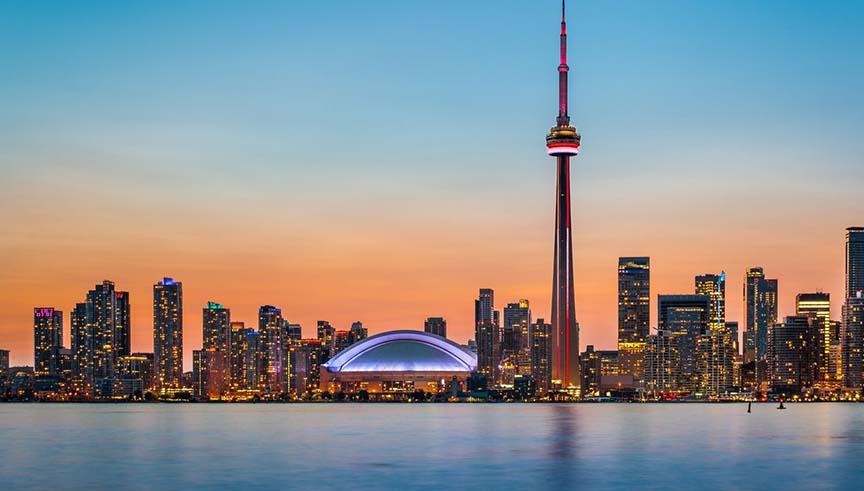
In that moment, it struck me that Toronto is not a city that clamors to assert its own existence, but rather a system in constant, steady operation.
Toronto’s sense of authenticity stems from its “structure”
The last time I looked back at the city before leaving was while waiting for my flight at the airport.
I reflected on the experiences of the past few days: the towering height of the CN Tower, the expanse of Lake Ontario, the sense of distance across the Toronto Islands, and the city’s ever-evolving culinary scene.
None of these elements was “stunning” in isolation, yet together, they formed a remarkably solid and coherent impression of the city.
Toronto does not captivate people through emotion; rather, it invites understanding through its structure.
If I were to summarize my experience in a single sentence, it would be this:
Toronto is not a city meant merely to be “seen,” but one to be understood through the logic of living.